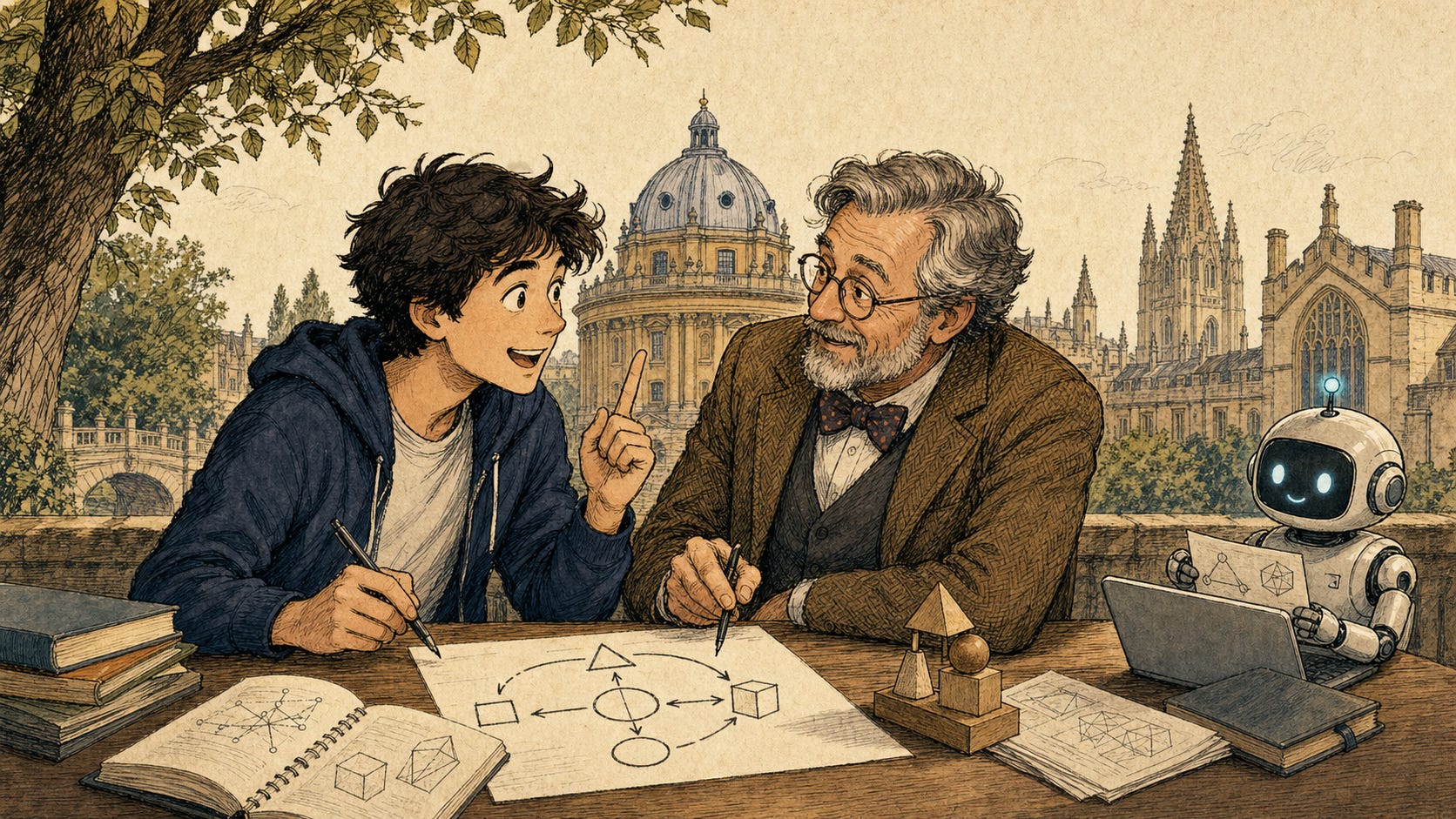
I have had several conversations recently with fellow academics about the effect of generative AI on assessment.
They describe setting reports, essays and other written assignments, only to add, with a sense of resignation, that students will probably use AI to complete them anyway.
Then comes the next part of the conversation.
Faced with large numbers of polished, AI-assisted submissions, teachers are increasingly tempted, or encouraged, to use AI to help mark them and generate feedback.
The whole process begins to resemble AI producing work for another AI to assess.
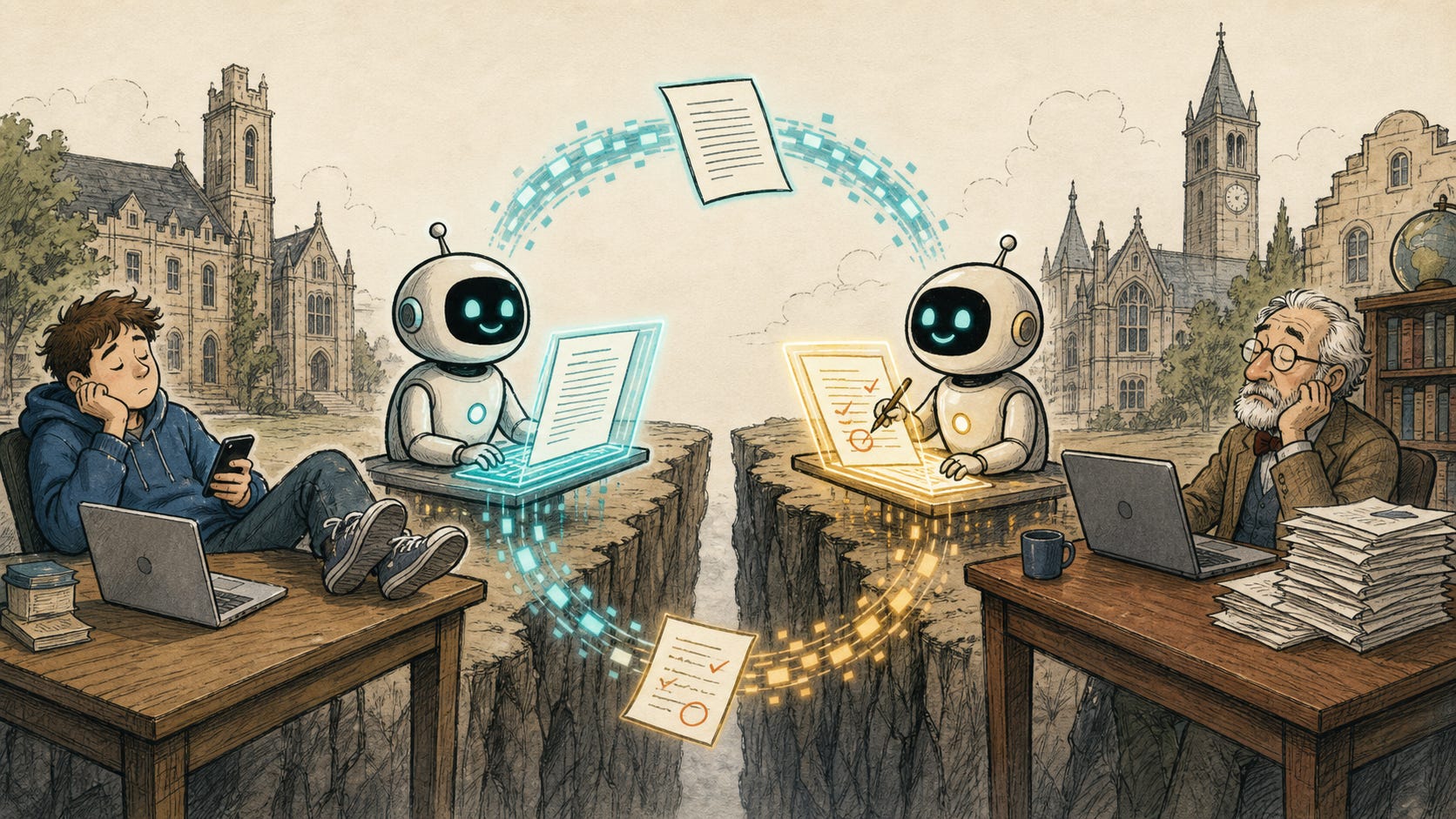
Students prompt a system to write the assignment. Lecturers submit the resulting work to another system to evaluate it. Feedback is generated, grades are awarded and everyone moves on to the next task.
At which point we have to ask: what is the point?
Why We Moved Away from Traditional Exams
Invigilated exams provide controlled conditions and confidence about who completed the work. However, universities reduced their reliance on them because of several limitations:
Recall over understanding: Exams can reward the ability to memorise and reproduce information rather than apply it thoughtfully.
A single snapshot: Performance on one stressful day may not accurately represent a student’s knowledge or development over time.
Limited authenticity: Most professionals use references, tools, feedback and collaboration rather than working alone from memory.
Little opportunity for feedback: Final exams generally assess learning after it has occurred, leaving students with little chance to improve.
Strategic learning: High-stakes exams can encourage cramming and predicting likely questions instead of curiosity and deeper engagement.
Equity and wellbeing concerns: Time pressure and exam conditions can disproportionately affect students with disabilities, health conditions or language barriers.
A narrow view of capability: Traditional exams struggle to assess skills such as collaboration, creativity, reflection, research and revision.
Universities did not move away from exams to make assessment easier. They wanted assessment to provide more meaningful evidence of what students understood and could do.
Then COVID Exposed the Holes in Remote Assessment
When COVID closed campuses, universities could no longer rely on supervised exam halls. Assessments moved online rapidly, often without enough time to redesign them for the new environment.
This exposed several weaknesses:
Uncertain authorship: Universities could not always be confident that submitted work had been completed independently by the student.
Easy access to outside help: Students could consult websites, notes, other people and unauthorised services during remote assessments.
Greater opportunities for collusion: Students could communicate and share answers during online tests.
Traditional exams did not transfer well: Moving the same timed test online removed the controlled conditions on which its reliability depended.
Remote proctoring created new problems: Surveillance software raised concerns about privacy, technical failures, accessibility and unequal home environments.
Take-home work relied heavily on trust: Essays and projects could support deeper learning, but the final product did not always reveal who had produced it or how.
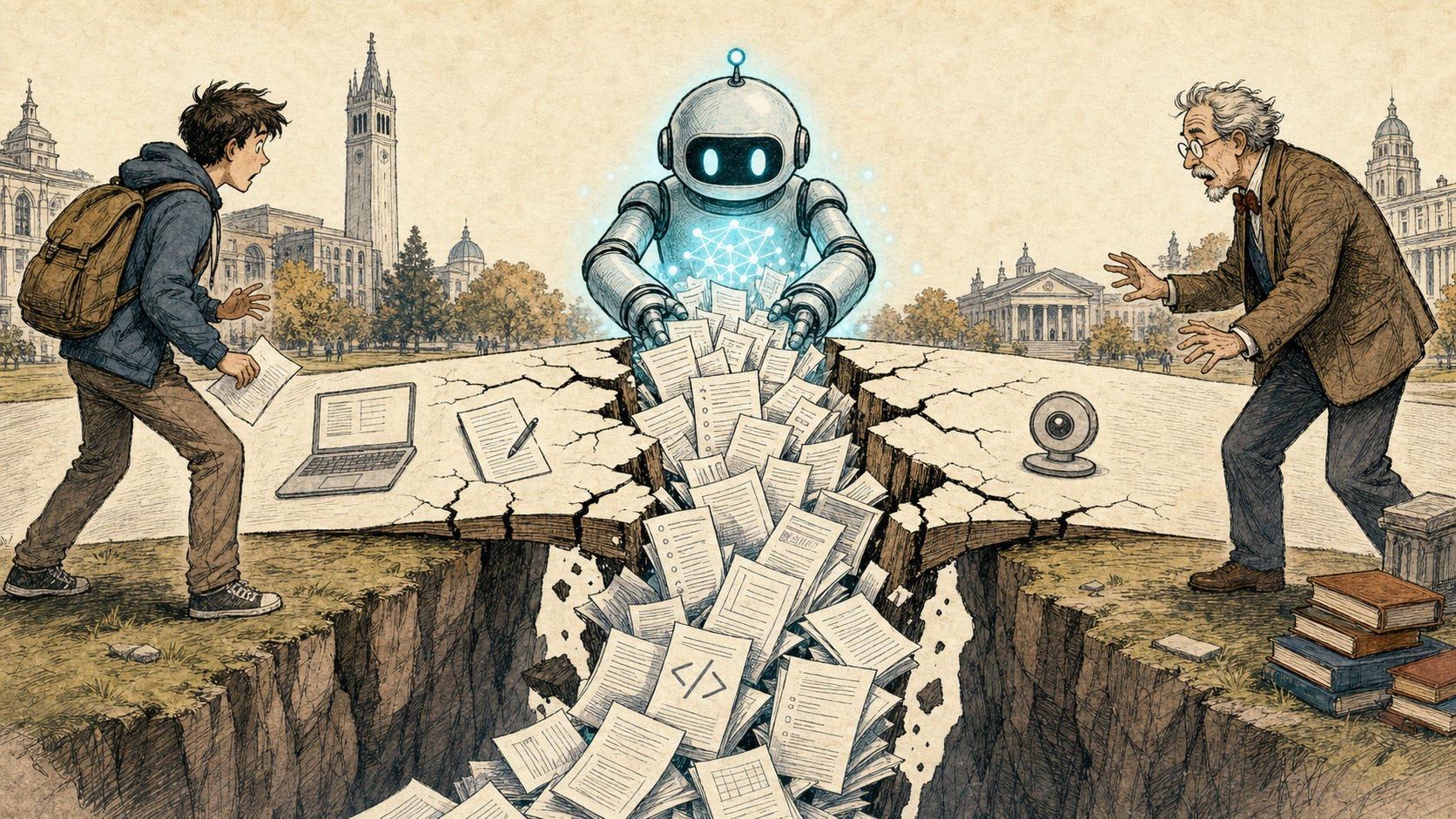
COVID did not create these weaknesses. It exposed how much assessment still depended on either physical supervision or trust in the authorship of submitted work.
Then generative AI arrived and widened those cracks.
So What Does This Mean for Future Assessment?
We know traditional exams provide secure conditions, but offer a limited picture of learning. We also know authentic tasks, such as projects, reports, case studies and portfolios, can assess more meaningful capabilities, but are increasingly difficult to verify.
Invigilation solves one problem, verification, but can recreate older ones.
A closed-book exam may show what students can recall under pressure. It may not show whether they can:
investigate a complex question;
collaborate;
use AI responsibly;
evaluate competing evidence;
revise weak work;
apply knowledge in a realistic situation.
The challenge is not to choose between security and authenticity. It is to design assessment that provides both.
This does not mean making every assignment “AI-proof.” That is unlikely to be possible or desirable. Instead, universities need multiple, connected forms of evidence that allow students to demonstrate both what they can produce and what they understand.
Several approaches could help:
Combine authentic and secure assessment: Students might complete a realistic project and then undertake a short supervised task applying the same knowledge independently.
Use oral defences: A conversation about submitted work can reveal whether students understand their argument, decisions and evidence.
Assess the process: Proposals, drafts, feedback responses and reflections can make the development of thinking more visible.
Observe performance: Presentations, demonstrations, simulations and practical tasks allow students to show what they can do in real time.
Ask students to critique AI: Rather than pretending AI does not exist, students can evaluate its output, identify weaknesses and justify their improvements.
Require transparent AI use: Students should explain where AI was used, what it contributed and how its output was checked.
Connect assessment across a course: Confidence should come from a pattern of evidence collected over time, not from one assignment or final exam.
Security should not simply mean placing students in a room without technology. It should mean having trustworthy evidence that the student possesses the knowledge, judgement and capabilities represented by the qualification.
The future of assessment is therefore unlikely to be entirely open or entirely closed. It will combine authentic tasks, responsible AI use and carefully designed opportunities for human verification.
The goal is not to prove that students can work without AI in every situation. It is to ensure they can still think, explain, judge and act for themselves.
Keeping Humans at the Centre
If a student uses AI to produce an assignment and a lecturer uses AI to assess it, we may have created an efficient process. But we have not necessarily created learning.
The answer is not to retreat entirely to the examination centre, nor is it to continue assigning work we no longer trust. It is to reconsider what assessment is for.
Assessment should create meaningful encounters between students, knowledge and human judgement.
It should give students opportunities to develop ideas, make decisions, explain their reasoning and demonstrate genuine understanding. AI can support that process, but it should not replace it.
The arrival of generative AI gives us an opportunity to address weaknesses that existed long before ChatGPT. We can retain the authenticity universities were seeking when they moved away from traditional exams while designing better ways to verify learning.
The important question is no longer simply, “Who produced this work?”
It is:
“What has this student learned, and how do we know?”
If our assessment practices cannot answer that question, returning to old methods will not be enough.
We need to design better ones!