
In the 1980s, Wendell Berry wrote Why I Am Not Going to Buy a Computer. He questioned the environmental costs of computer use and dependence on energy corporations.
Sound familiar?
Today’s students raise similar concerns about generative AI. They also question the use of creators’ work without permission, the labour behind these systems and what happens to information they share with a chatbot. Having these concerns does not necessarily mean they stop using AI.
For some, the concern is about learning itself. They want their work to reflect their own thinking and voice. They worry that handing the process to AI removes the struggle through which understanding develops.
As AI becomes part of more learning activities, how should we respond when students decline to use it?
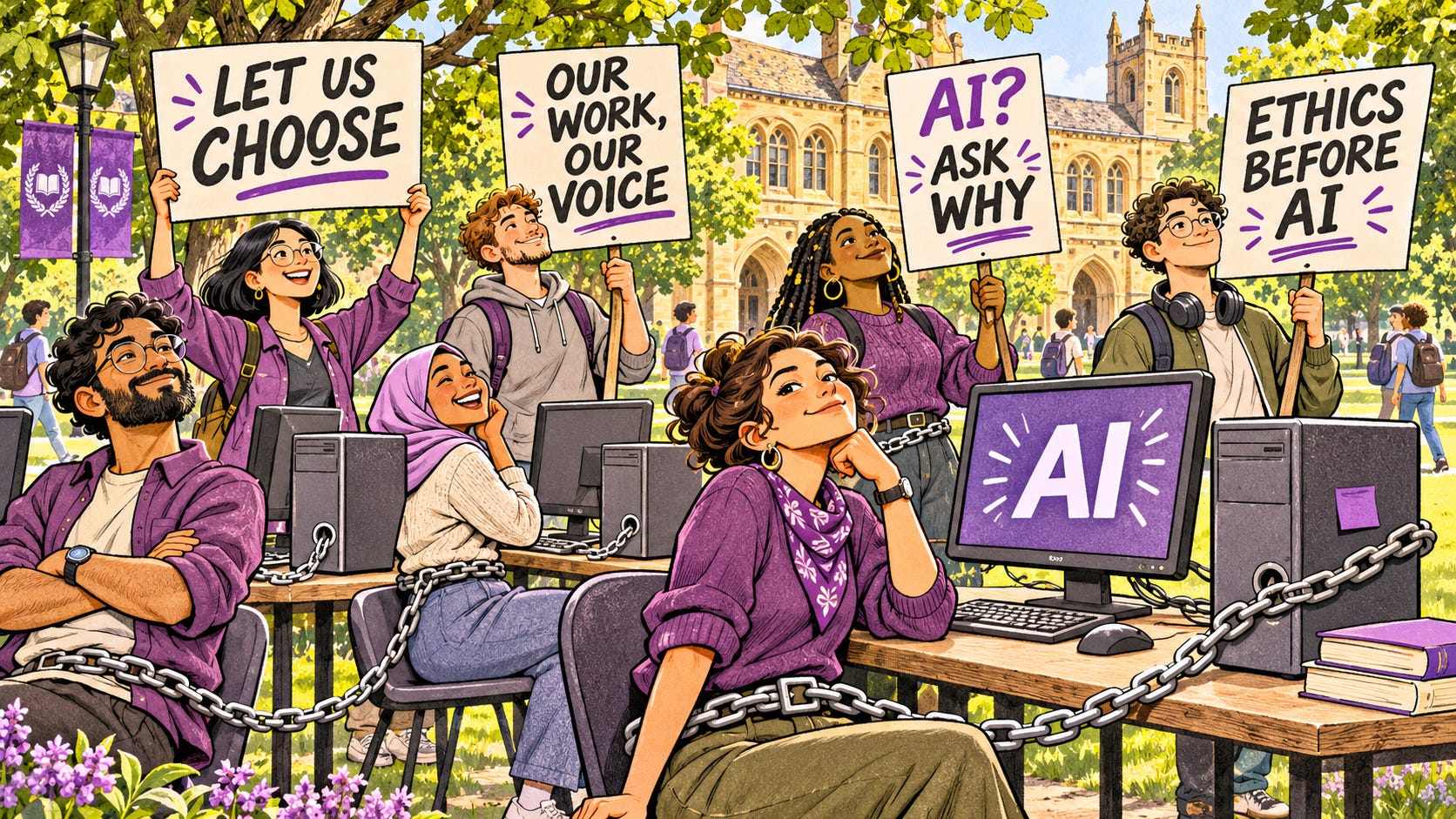
We should expect informed judgement.
What can history teach us?
Education has faced ethical refusal before. Students have objected to animal dissection while still wanting to study anatomy. Universities have responded by developing conscientious-objection policies and considering alternatives. A 2013 paper describes this process at the University of Adelaide.
The question is familiar: can another activity demonstrate the same learning? Analysing supplied AI outputs might demonstrate critical evaluation, but it would not necessarily demonstrate the ability to work interactively with a model.
Turnitin offers a closer technological comparison. In the 2000s, students challenged the compulsory archiving of their assignments in its commercial database. The US appeal upheld the archiving as fair use, but the dispute raised questions about consent and control over student work.
Archiving assignments differs from training AI models. Still, both prompt us to ask what students must agree to as a condition of completing an assessment. Does the learning require this particular platform? Could another arrangement address their objection?
The free software movement raises another question. Richard Stallman argues that schools should use software students can inspect, modify and share, rather than develop dependence on proprietary products. Are we teaching transferable capabilities, or familiarity with a company’s tools?
These examples do not establish an automatic right to opt out. They do suggest that we should examine our requirements as carefully as we examine students’ objections.
I would start with four questions:
What exactly is the student refusing?
What learning would remain undemonstrated?
Could another activity provide equivalent evidence?
Can I explain why the required activity is necessary?
Can we address the concern and preserve the learning?
An alternative does not always need to remove AI. Changing the tool, the material shared or the purpose of an activity may help.
For privacy concerns, use fictional material in an approved environment with checked data-handling arrangements.
For authorship and independent learning, ask students to attempt the task themselves before evaluating AI feedback. Assess what they accept, reject and change, and why.
For environmental concerns, use existing examples, share outputs or limit generation to interactions with a clear learning purpose.
For copyright and labour concerns, examine providers’ disclosures and consider whether another tool meaningfully addresses the objection. Local hosting and openly available model weights do not, by themselves, resolve questions about training data or labour.
For bias concerns, make testing and challenging the system part of the activity. A student who rejects AI-generated writing may still be willing to investigate misleading explanations or insecure code.
None of these arrangements guarantees that the concern is resolved. The alternative must address the objection and still demonstrate the required learning.
Can students afford not to learn about AI?
I think there is an important distinction between declining a particular use and refusing to learn about the technology.
As AI influences work across professions, students need enough understanding to evaluate its usefulness, limitations and consequences. That knowledge can strengthen an objection. It may also lead them to reconsider it.
This is particularly relevant in computer science. Students may encounter AI as a development tool, a system component or a subject of investigation. Advising against its deployment can be a professional responsibility, but that advice needs to be informed.
Sometimes practical engagement will be essential. Reading about an AI workflow does not necessarily demonstrate the ability to implement, test and manage one. Educators must justify the requirement and consider alternatives. Students must still demonstrate the capability.
If a student rejects every form of engagement essential to their chosen specialisation, a conversation about their study and career direction may be necessary. We should explore compatible pathways within computing, which also needs people prepared to question AI adoption.
We should not require enthusiasm. We should expect informed judgement. Graduates need to explain when AI is useful, when it is harmful and why their decision to use or refuse it is justified.