
Yesterday, I was working with ChatGPT to put together a spreadsheet for budgeting casual teaching staff. I needed to calculate the number of tutors required for particular jobs and the total number of hours of work involved. There were quite a few variables and some rather involved calculations. It was precisely the sort of job I was happy to hand over to AI.
However, something caught my eye.
Let me simplify the problem. If I have 10 tutors who each need to work three hours, a quick calculation in my head tells me that I have 30 hours of work to pay for. Yet, in my spreadsheet, the total number of hours was actually less than the number of tutors required.
Something was clearly not right.
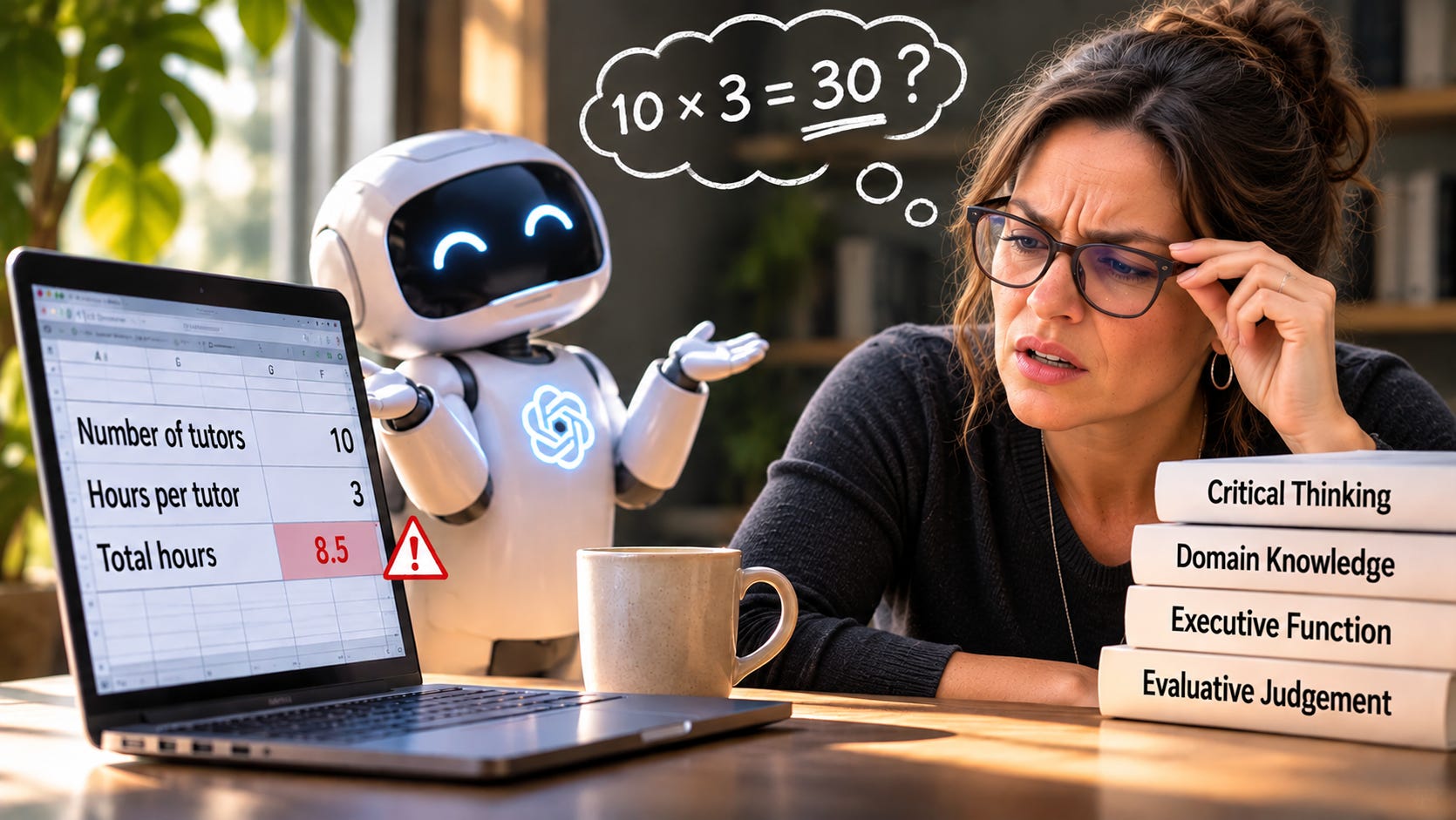
I didn’t need to inspect every formula or ask ChatGPT to check its work. My own knowledge and experience told me that something had gone awry.
It got me thinking about our students.
We already have concerns about students accepting what generative AI produces without critically evaluating it. In a study of 26 Australian university students, Walton et al. (2026) examined students’ interactions with generative AI while undertaking assessments. Among the behaviours they identified were “adopting ideas with low levels of criticality” and “submitting GenAI content in an assignment without judging it.”
Interestingly, Lee et al. (2025), in a study of 319 knowledge workers, found that greater confidence in generative AI was associated with less critical thinking, whereas greater confidence in one’s own abilities was associated with more.
Think about that in the context of a novice learner. A student with little confidence in their disciplinary knowledge but considerable confidence in AI may be particularly unlikely to question what it produces.
At least with conventional generative AI, students still have opportunities to exercise some executive function. They decide what to ask, how to respond, whether to ask another question and what to do with the information they receive. Whether they take advantage of these opportunities is another matter.
If we are already concerned about the extent to which students exercise these capabilities when prompting AI, how much more concerned should we be when they can delegate the entire process?
Welcome to the world of agentic AI.
From prompting to delegating
Just when we were beginning to get our heads around generative AI in education, along comes agentic AI.
Rather than instructing AI at each step of a process, we can give it an overarching goal and allow it to work out how to achieve it. It can formulate a plan, use tools, gather information, make decisions and revise its work with varying degrees of autonomy.
Imagine giving an AI agent an assignment specification and a marking rubric with the instruction, “Complete this assignment to a distinction standard.”
The agent could research the topic, formulate an argument, write the report, evaluate it against the marking rubric and revise it accordingly.
The student could go off and make a cup of coffee.
Of course, outsourcing cognitive activities is nothing new. Psychologists Risko and Gilbert (2016) describe this as cognitive offloading. We’ve been doing it for years with calculators, notebooks, calendars and search engines.
But there is a difference between using a calculator to perform a calculation and asking an AI agent to determine what needs calculating in the first place.
Perhaps we are moving beyond cognitive offloading into something we might call cognitive delegation. We are handing over not only the execution of a task but also its conception, planning and evaluation.
And we already have evidence that completing a task successfully with AI does not necessarily translate into learning.
In an experimental study involving nearly 1,000 high school mathematics students, Bastani et al. (2025) found that students using a conventional generative AI interface improved their performance on practice problems by 48%. However, when the AI was taken away, these students performed 17% worse than those in the control group. Interestingly, a version of the AI tutor specifically designed to safeguard learning largely mitigated this negative effect.
So, it isn’t necessarily the AI that is the problem. It’s what the student does, or doesn’t do, while using it.
Now, before you suggest that agentic AI is simply another way for students to cheat, I think there is a much bigger issue here. Delegating complex tasks to intelligent systems is likely to become an increasingly valuable professional skill. We should be preparing our students to do it.
The question is, how?
How do you know what you don’t know?
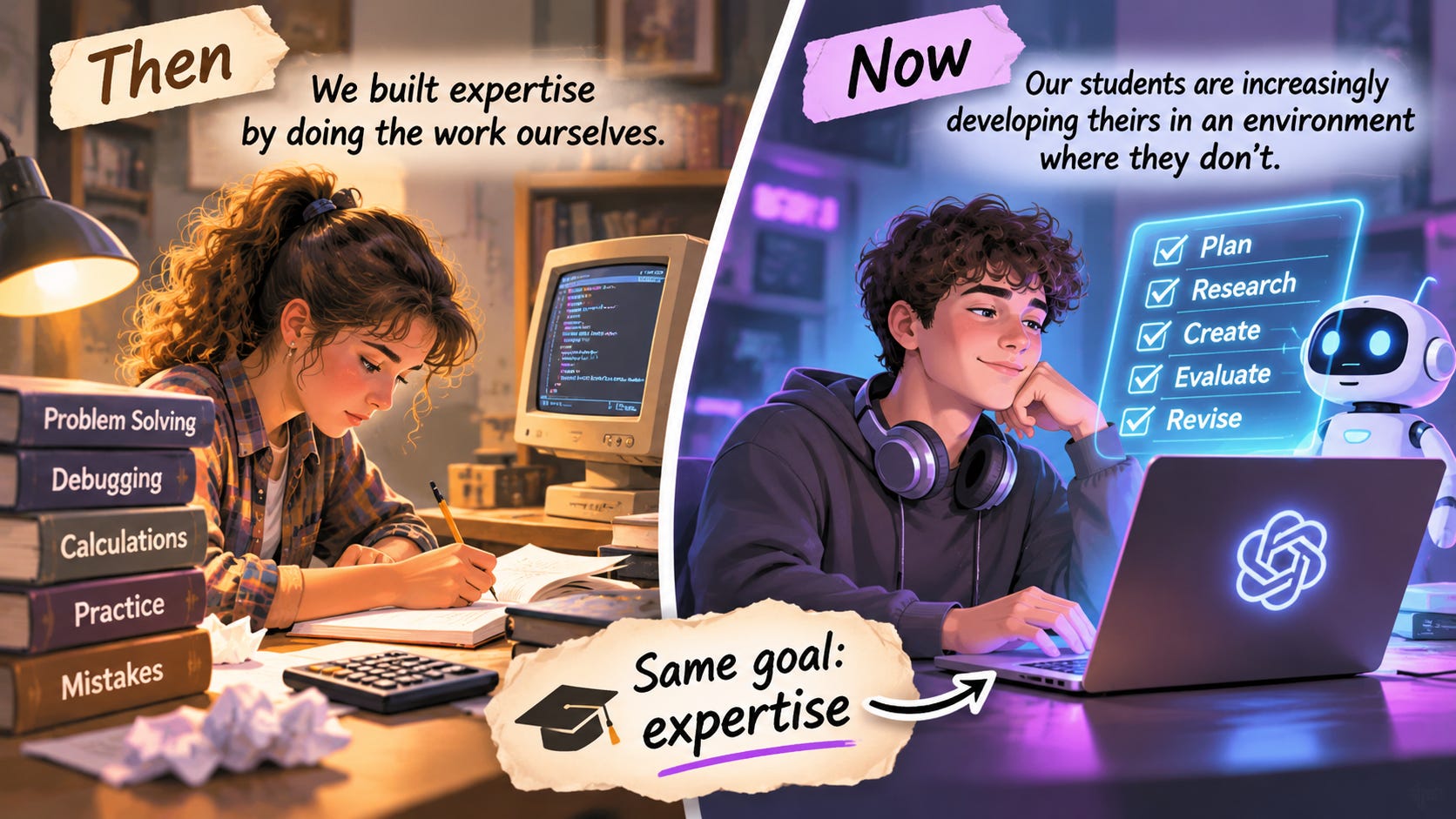
Going back to my spreadsheet, I was able to recognise that something was wrong because I had spent years doing calculations, writing formulas, debugging code and, importantly, making mistakes. Somewhere along the way, I developed a sense of what a reasonable answer looks like.
I suspect many of us who are experienced in our respective disciplines use AI in much the same way. We hand over a task, look at what comes back and draw upon our accumulated expertise to determine whether it makes sense.
But here’s the catch. We developed much of that expertise in an environment where we had to do the work ourselves. Our students are increasingly developing theirs in an environment where they don’t.
We have a tendency in education to talk about critical thinking as though it were a generic skill that can be applied to anything. However, cognitive psychologist Daniel Willingham (2008) points out that:
“The processes of thinking are intertwined with the content of thought (that is, domain knowledge).”
I didn’t recognise the error in my spreadsheet because I’d attended a professional development workshop on critical thinking. I recognised it because I knew something about mathematics, spreadsheets and the work for which I was budgeting.
Asking a student who has never written software to critically evaluate AI-generated code is a little like asking someone who has never cooked to work out what went wrong with a soufflé. They might recognise that it has collapsed, but understanding why is another matter altogether.
This presents us with what I would call the expertise paradox.
We are asking students to develop the expertise necessary to supervise AI while simultaneously giving them the means to circumvent the experiences through which that expertise is acquired.
Perhaps the next time we tell our students to critically evaluate the output of AI, we should ask ourselves a rather important question.
With what knowledge, exactly?
The paradox of the agentic student
There’s something rather ironic about the term agentic student. In education, student agency refers to students taking ownership of their learning, making decisions and exercising autonomy. Yet, as students give more agency to AI, there is the potential for them to exercise less of their own.
In her review of executive functions, Diamond (2013) discusses working memory, cognitive flexibility and inhibitory control, which underpin more complex activities such as reasoning, planning and problem-solving. Importantly, these capabilities can be strengthened through practice.
Now consider what an AI agent does. It plans, breaks down problems, selects strategies, monitors progress and adapts its approach when things don’t go according to plan.
Sound familiar?
My concern is not that AI agents can undertake these activities more efficiently than our students. It is that students may have fewer opportunities to practise them.
We’ve spent the past few years discussing the implications of AI generating the products of learning. Perhaps it’s time we started discussing the implications of AI undertaking the processes of learning.
Of course, a student who sets objectives, challenges an agent’s decisions and independently evaluates its work may be exercising considerable personal agency. The use of an AI agent doesn’t necessarily diminish student agency.
But do our students know how to exercise it in this context? And are we teaching them to do so?
Becoming an expert delegator
I have absolutely no desire to go back to manually performing every calculation in my spreadsheets. There is enormous value in being able to delegate work to AI.
However, there is a fundamental difference between an expert delegating a task they understand and a novice delegating a task they have yet to learn.
Perhaps what we need to develop alongside AI literacy is something we might call delegation literacy. This is not simply knowing how to get AI to do something. It is knowing what to delegate, what not to delegate, when to intervene and how to independently determine whether the job has been done properly.
And, from an educational perspective, knowing when doing something yourself is more valuable than having it done for you.
I might be quite happy for a final-year computer science student to delegate the implementation of a particular algorithm to AI. I would be considerably less comfortable with a first-year student doing the same thing if the purpose of the exercise was to develop their understanding of algorithms.
Same technology. Same task. Very different educational implications.
Rather than asking whether AI should be permitted in a particular assessment, perhaps we should be asking which parts of that assessment a student can afford to delegate without compromising their learning.
Perhaps we need to assess the ability to recognise mistakes
Interestingly, the higher education literature was addressing aspects of this issue well before generative AI came along.
Tai et al. (2018) define evaluative judgement as:
“the capability to make decisions about the quality of work of oneself and others.”
Traditionally, we have developed this capability through activities such as peer assessment, self-assessment, feedback and examining examples of work of varying quality.
We now have another source of work to evaluate.
Bearman et al. (2024) extend evaluative judgement into the context of generative AI, arguing that students need to be able to judge both AI-generated outputs and the processes through which they are produced.
With agentic AI, students will also need to evaluate the appropriateness of the decisions an AI makes autonomously along the way.
What if, rather than always asking students to produce something, we occasionally gave them something that AI had already produced? Something sophisticated, plausible and professionally presented, but containing subtle mistakes.
Could they identify an unreasonable result in a spreadsheet, a security vulnerability in a piece of software or an inappropriate statistical method in a research paper? Could they explain why it was wrong and how to rectify it?
We could also give students control of an AI agent and observe how they manage it. When do they intervene? What assumptions do they challenge? What do they independently verify? What do they accept without question?
I’d also like to see students predict what a reasonable answer might look like before handing a task over to AI. Had my spreadsheet been concerned with a subject outside my expertise, would I have been so quick to spot the error?
After all, what use is being able to delegate a task if you have no idea whether it has been completed correctly?
Who is getting the education?
I’m excited about what agentic AI will enable our students to do. They will be able to undertake projects of a scale and complexity that previous generations could only have dreamed of within the confines of a university assignment.
But the sophistication of what a student produces is no longer necessarily an indication of the sophistication of their understanding.
Yesterday’s spreadsheet incident was relatively mundane, but it served as a reminder of just how much knowledge I bring to my interactions with AI without even realising it.
How do we ensure that our students acquire that knowledge?
We don’t yet know the long-term educational consequences of delegating entire intellectual workflows to AI. The research into generative AI gives us reasons to be concerned, but we need further research specifically into agentic AI and learning.
In the meantime, I don’t think the answer lies in banning AI or insisting that students undertake every task without it. Rather, we need to identify which intellectual experiences are essential to the development of expertise and make sure our students actually have those experiences.
Getting the job done and getting an education are not necessarily the same thing.
We can teach students to delegate their work, but we must be careful not to teach them to delegate their learning.
References
Bastani, H., et al. (2025). Generative AI without guardrails can harm learning: Evidence from high school mathematics. Proceedings of the National Academy of Sciences, 122(26), e2422633122. https://doi.org/10.1073/pnas.2422633122
Bearman, M., Tai, J., Dawson, P., Boud, D., & Ajjawi, R. (2024). Developing evaluative judgement for a time of generative artificial intelligence. Assessment & Evaluation in Higher Education, 49(6), 893–905. https://doi.org/10.1080/02602938.2024.2335321
Diamond, A. (2013). Executive functions. Annual Review of Psychology, 64, 135–168. https://doi.org/10.1146/annurev-psych-113011-143750
Lee, H.-P., et al. (2025). The impact of generative AI on critical thinking: Self-reported reductions in cognitive effort and confidence effects from a survey of knowledge workers. Proceedings of the 2025 CHI Conference on Human Factors in Computing Systems. https://doi.org/10.1145/3706598.3713778
Risko, E. F., & Gilbert, S. J. (2016). Cognitive offloading. Trends in Cognitive Sciences, 20(9), 676–688. https://doi.org/10.1016/j.tics.2016.07.002
Tai, J., Ajjawi, R., Boud, D., Dawson, P., & Panadero, E. (2018). Developing evaluative judgement: Enabling students to make decisions about the quality of work. Higher Education, 76, 467–481. https://doi.org/10.1007/s10734-017-0220-3
Walton, J., Bearman, M., Crawford, N., Tai, J., & Boud, D. (2026). How university students work on assessment tasks with generative artificial intelligence: Matters of judgement. Assessment & Evaluation in Higher Education, 51(6), 1066–1082. https://doi.org/10.1080/02602938.2025.2570328
Willingham, D. T. (2008). Critical thinking: Why is it so hard to teach? Arts Education Policy Review, 109(4), 21–32. https://doi.org/10.3200/AEPR.109.4.21-32